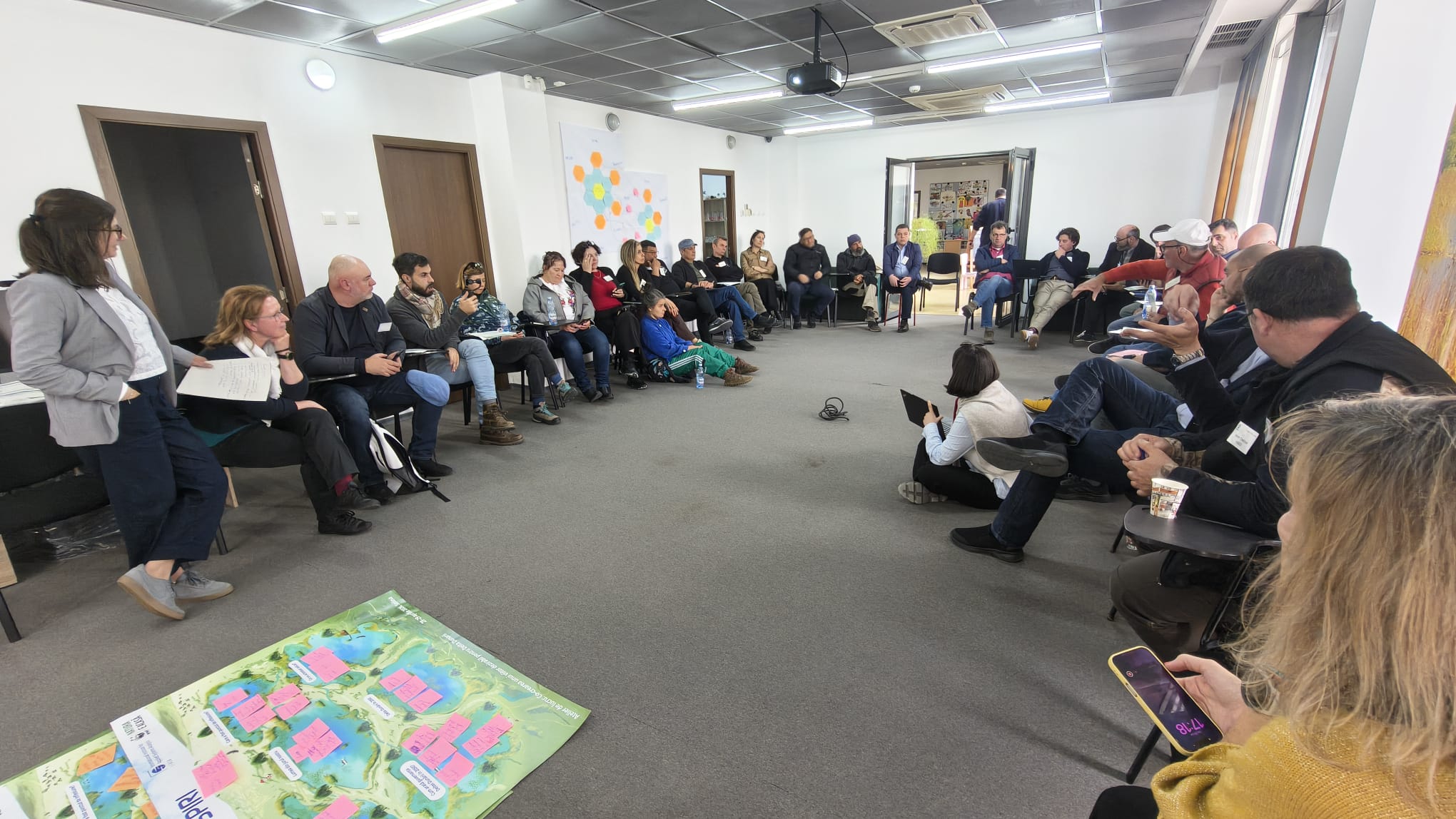
On a spring day in Sulina, Romania’s easternmost point and the only city in the Danube Delta, a diverse group gathered around maps, sticky notes and blank sheets waiting to be filled. The invitation was simple but powerful: “Imagine it is 2050. The Danube Delta is thriving. How did we get here?” As people compared memories and hopes about water, livelihoods, traditions, and the future of their communities, the room shifted from describing problems to sketching possibilities.
CONTEXT
This participatory visioning workshop is part of INSPIRI (Imaginative Narratives and Scenarios for Inspiring Restoration and Innovation for European Seas and Water Systems), a Horizon Europe research and innovation project that brings together citizens, scientists, policy-makers and artists across four Mission Lighthouse regions, including the Danube (freshwater).
The Danube Delta is one of Europe’s most valuable ecological areas-and a place where environmental integrity, livelihoods, traditions, demographic diversity and governance are tightly interconnected. As the downstream expression of the wider Danube Basin, it reflects local dynamics (such as land-use change, intensive agriculture or depopulation) alongside upstream pressures. In such complexity, the workshop’s premise was that scientific data matters-but co-creation and more human, artistic ways of working with knowledge help build shared understanding and acceptance.
WHO WAS IN THE ROOM
Around 30 participants joined from across the Delta region, with perspectives spanning research and science, public authorities, civil society, local community voices and artists.
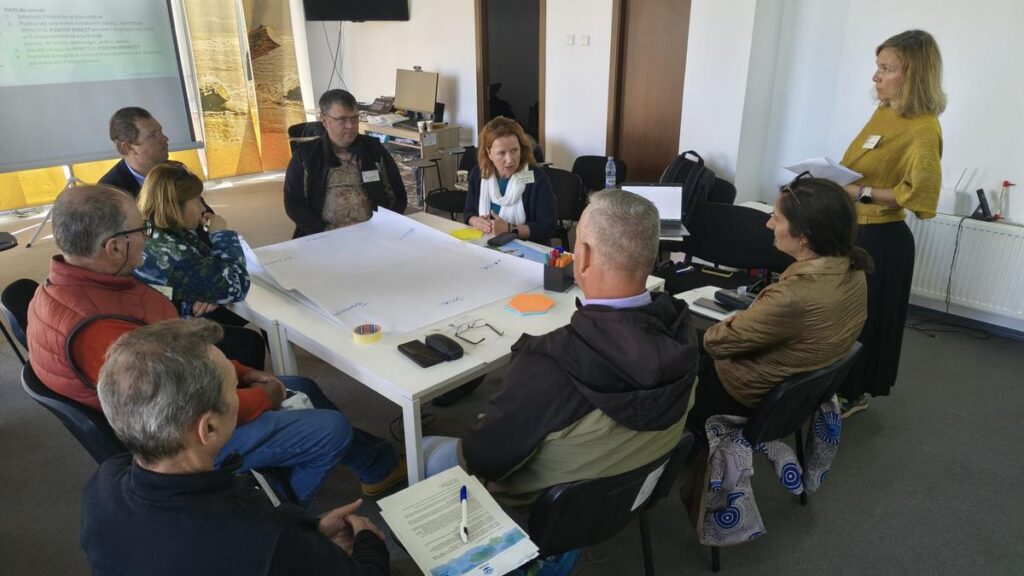
THE WORKSHOP IN ACTION — SCIENCE MEETS IMAGINATION
The workshop followed a two-step logic: from dreaming to planning. On Day 1, a “future-first” approach invited participants to co-create pluralistic and inspiring visions for 2050 for the Danube Delta. Using the Nature Futures Framework and the Seeds of Good Anthropocenes as prompts, groups explored different relationships between people and nature (nature for nature, nature for society, and nature as culture) and what each could mean in the Delta context.
On Day 2, those visions were translated into transformation pathways: identifying barriers, enabling conditions and strategic directions of change, then exploring how these insights could support the Danube Lighthouse objectives more broadly.
Participants responded particularly well to the mix of realism and optimistic foresight entailed by the workshop methods. While they retained a clear view of the financial, educational and legislative changes needed in the near future, they did not hesitate to picture futures in which all these and more have been dealt with. And allowing this leap of imagination was one of the purposes and achievements of the workshop.
“The locals participating in the workshop had a very clear understanding of the fact that, in order to save tomorrow’s ecosystems, we must act today.”
dr. Valentin Dinu of the Research Center in Systems Ecology and Sustainability, University of Bucharest
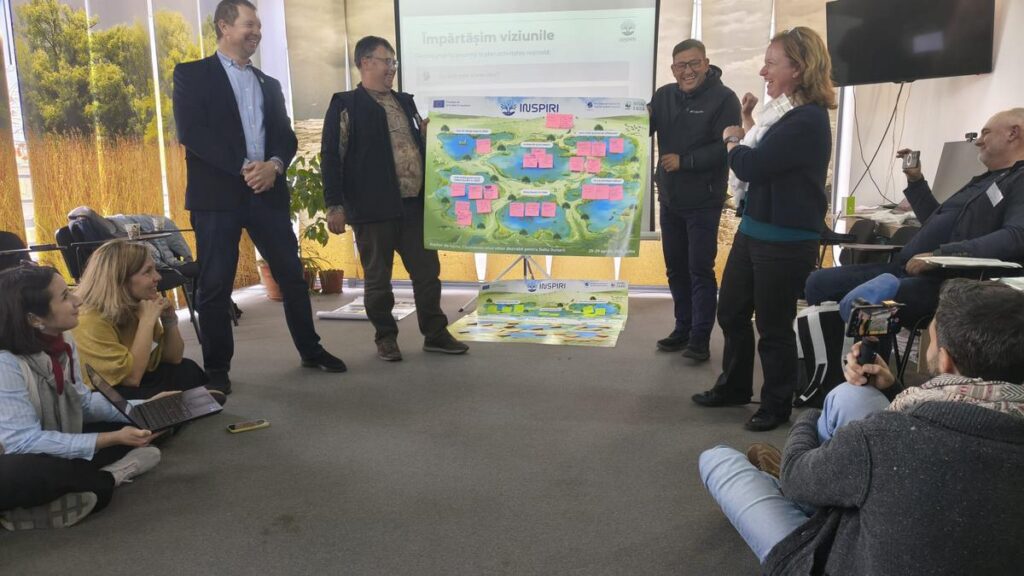
ART-SCIENCE IN PRACTICE
A distinctive element of INSPIRI is the deliberate linking of science with imagination and artistic practice. At this workshop, the role of arts & culture was not an “add-on”, but part of creating a space where people could express futures as stories, values and lived experiences-helping complex data and system dynamics become discussable in everyday language. Two artists were part of the working groups and helped channel the discussions, and were instrumental in dismantling preconceived ideas – about what a workshop is, what ideas are ‘permitted’ and how far participants are ‘allowed’ to dream.
“One cannot make predictions, but the fact that people wish for a future that is closer to nature, and better connected to nature, is already promising.”
Floriama Cândea, artist working at the crossroads of art and science
VOICES FROM THE ROOM
“The diverse participation in this workshop mirrors the diversity and complexity of the Danube Delta itself”
Corina Gheorghiu, Freshwater Expert, WWF-Romania
“The biggest advantage gained from today’s exercise was that it managed to bring several Delta actors around the table. It brought townships, private enterprises… all those involved with the Delta. Which is a big thing. We were just talking about this earlier. An NGO came to unite us, to sit us around the same table. This is the most important thing.”
Timur Ciauș, Mayor of Chilia Veche
“From vision to identifying causes and then countering them, there is a big step to take. It is a big step, because we are waiting for change to come from somewhere. Change will not come from somewhere. It can start with small steps from each and every one of us.”
Călin Ene, tourism entrepreneur in Sulina
WHAT EMERGED — KEY VISIONS AND INSIGHTS
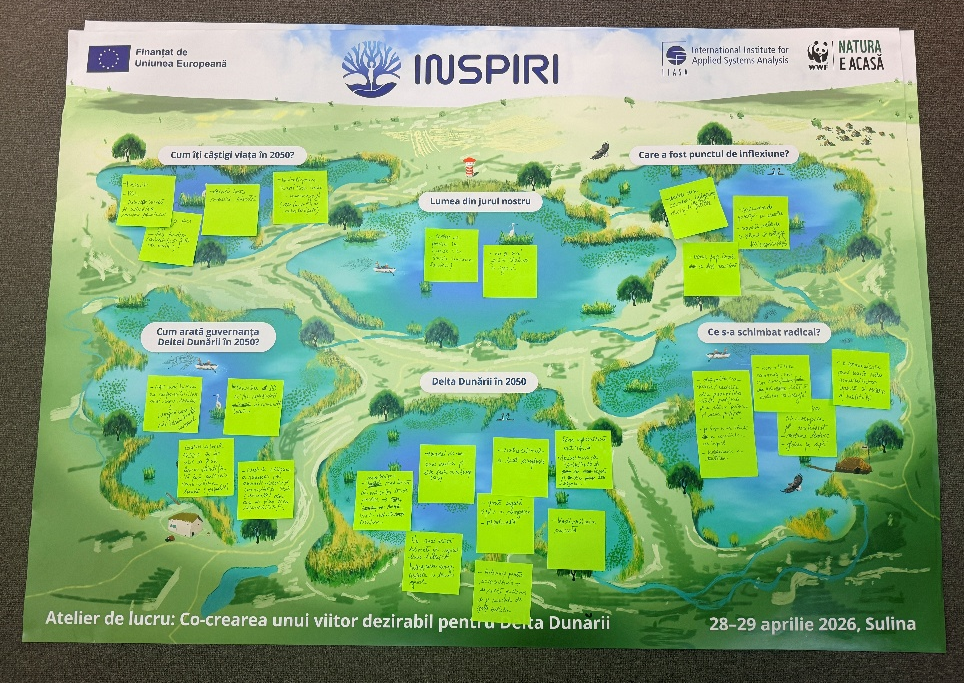
Across groups, common visions for 2050 included a Danube Delta with no pollution, enabled by better technology, improved law enforcement, a stronger biosphere reserve administration and better coordination with upstream Danube countries. Another shared vision focused on higher biodiversity, supported by habitat restoration, no poaching and a better use of natural resources.
Participants also highlighted what would make those futures possible: appropriate financing, clearer responsibilities and a shift from central to more locally grounded decision-making, with scientific data used more consistently in policy choices.
Just as importantly, ecological recovery was linked to social wellbeing. Many participants indicated the restoration of former ponds (nowadays agricultural polders) as the way towards a sustainable Delta. In these futures, the Delta is no longer defined by depopulation; local wellbeing rises as economic activity becomes better calibrated to local resources-rooted in slow tourism, traditional gastronomy and revitalised crafts (with a contemporary twist shaped by real community needs). The Danube Delta, in this framing, becomes a model of good practice in Europe.
LOOKING FORWARD
The workshop outputs will feed into INSPIRI’s wider process of turning co-created visions into scenarios that can inform restoration pathways and decision-making across the Danube Lighthouse region. Moreover, this was one of the promises that co-organizers WWF-Romania made to the participants: ensuring that these visions do not stay on paper, but are being forwarded to decision-makers and become part of how Romania and Europe learn to restore waters and support communities together.