Between September 8th and 10th 2026, a group of 27 participants and 11 conveners joined forces in the stunning Stockholm Archipelago to envision preferable futures for the Baltic Sea surrounding them.
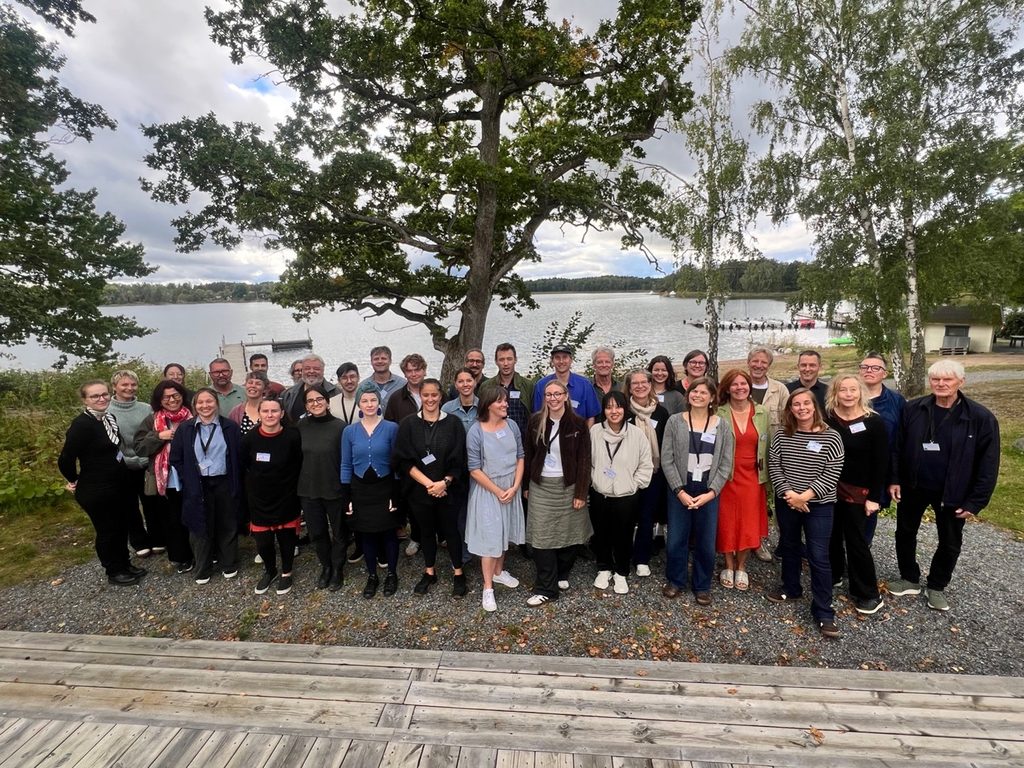
The shuttle bus wound its way out of Stockholm City on Tuesday morning and into the beautiful archipelago, filled with excited chatter as old and new friends reconnected, introductions were made, and anticipation grew for the conversations and future visions that lay ahead for their Baltic Sea.
After an hour it arrived at the venue on the island of Marholmen, a place emblematic of the Baltic region and its thousands of islands. A carefully selected group of participants disembarked the bus, bringing with them experiences from gastronomy, conservation, marine governance, fisheries, engineering, defense, education, research, communication, more-than-human perspectives, community empowerment, art and co-creation (among other passions!).
Why this workshop, why NOW!
“Imaginative Narratives and Scenarios for Inspiring Restoration and Innovation for European Seas and Water Systems” (INSPIRI) is an EU funded project which aims to strengthen the capacity to improve and restore the health of Europe’s oceans and water systems across four Lighthouse regions. The Baltic Sea is one of these Regions as it represents an ideal “living lab” for high-intensity maritime activity and severe environmental vulnerability. The world’s largest brackish water basin faces multiple, interconnected pressures, including nutrient pollution and widespread oxygen depletion, intensive human activities, invasive species, and growing geopolitical uncertainty. Although science and research help us understand these current challenges, the exercise of visioning allows us to look beyond what is happening today and imagine what the Baltic could become. This is what the 3rd workshop in the INSPIRI visioning sequence aimed at doing. “Imagining futures of our waters. Together.”
Who was in the room
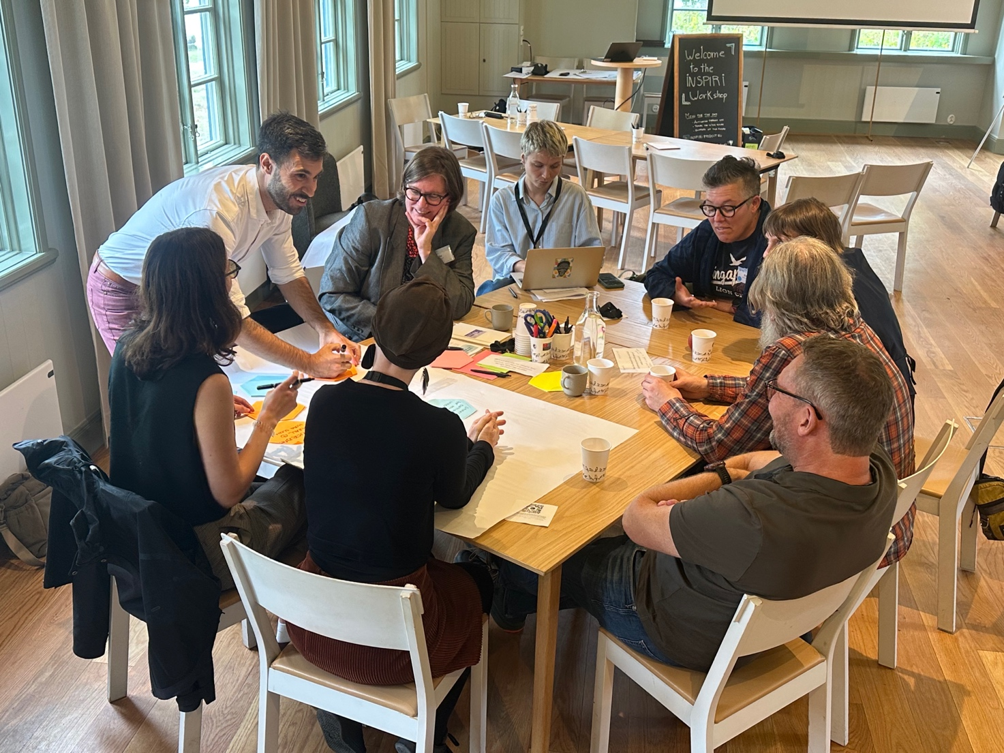
Each of the four working groups in the workshop brought their own distinctive ‘flavour’ of perspectives, experiences and passions, shaped by their different connections with the Baltic Sea. Present in these groups were researchers, art curators, civil servants, sci fi writers, consultants, activists, chefs, designers, practitioners, divers, policy analysts, and explorers. Each group was also given a variety of seeds – emergent initiatives that offer pockets of the future in the present – to work with. This led to various diverse mixes of creativity, imagination, radical thinking, strategics, and nature-oriented values or connections.
Science meets imagination
The workshop was built around three steps over three days. Day 1 supported the exploring of ideas and possibilities. Day 2 built on those ideas to imagine desirable futures and pathways for change. Finally, Day 3 was about further concretizing those pathways to change.
Day 1 began with the Nature Futures Framework (NFF) triangle, which allowed participants to reflect on our different ways of valuing and relating to nature. Breaking out into our groups, they then explored the example seeds they had been given (see this report which lists some of the innovative Baltic activities in the present). Using Futures Wheels, they considered the potential consequences of these initiatives before mapping how they might interact through a cross-impact matrix to generate new ideas. Each group then took key themes to prototype a speculative future and then share it with the whole group by way of a memorial service from the future which they performed before dinner. These performances captured the story of ‘Sally the last salmon’, an ode to the bladderwrack (a key Baltic Sea seaweed species) as well as an imaginary educator and activist – Ahti ‘the voice of the Baltic’. The process was both joyous and serious.
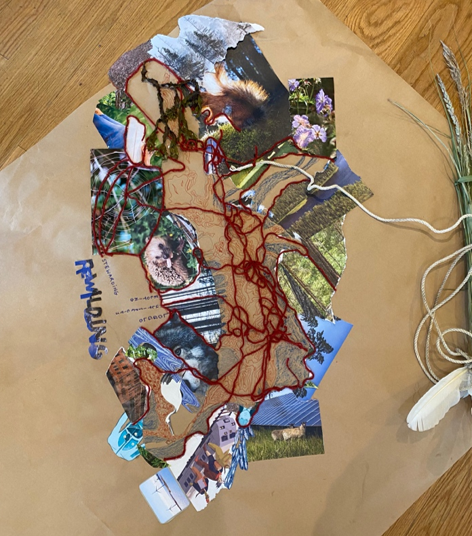
On Day 2 through storytelling and collaging, the groups explored what life might look and feel like in their emerging futures. They were guided to consider different aspects of society, technology, the environment, the economy, politics, and values. Using the Iceberg Model, they looked beneath visible problems to consider the systems, structures and underlying assumptions that sustain them. Participants played with ideas of matriarchal governance systems, a Baltic Island Union, ‘smaller’ or more ‘local’ community living, self-sufficiency and care, solar fishing fleets, Baltic punk idols (akin to Solar Punk), Indigenous led marine revitalization and more! Futures were shared in plenary through a ‘press conference’ whereby the audience was encouraged to question how this future might work in more detail. Day 2 culminated in some well needed sauna and hot tub time before a scrumptious dinner.
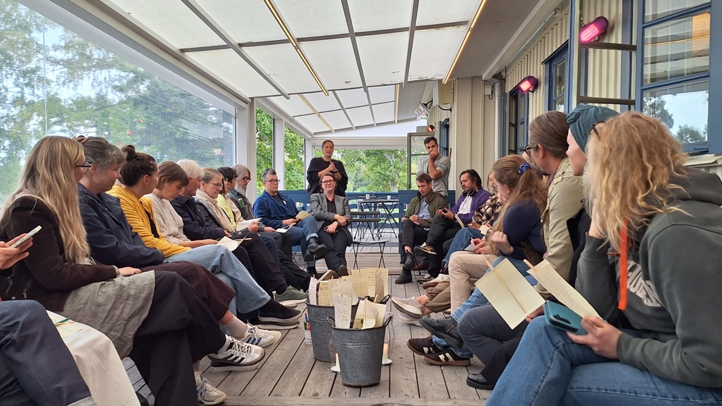
On the final day, each group selected a priority theme from its vision and developed a more focused transformation pathway. This involved identifying potential actions, the actors who could help bring about change, and possible indicators of progress. The workshop was concluded in a reflective circle outside on the terrace where one-by-one each participant shared their thoughts, keywords and what they might carry forward through the wider INSPIRI project and their work.
“This is only the beginning and soon you might see initiatives coming from these days of creativity”
Innovator, activitist & entrepreneur with — Under Ytan
Art-science in practice
The mix of participants which included artists, VR game designers, storytellers and poets brought a different energy to the workshop, helping many participants move beyond conventional research discussions and engage with the Baltic Sea’s futures through creativity, play and imagination. They supported groups in developing visual collages and performing their futuristic funeral skits, using images, objects and storytelling to bring their ideas to life.
Importantly, their role was not simply to produce art themselves, but to encourage others (often implicitly) to experiment, think differently and take creative risks, helping ideas flow in unexpected directions e.g. Baltic Yoga. Art became a shared process rather than the preserve of those who identify as ‘artists’.
“Telling hopeful Solar Punk* stories isn’t easy, but it gets more tangible with your insights.”
Design & artist /Neonature*A creative genre and movement that imagines a future in which people live more equally, society is sustainable, and humans, the natural world and renewable technologies coexist in balance
A two-minute video overview of the INSPIRI Baltic Workshop. (I Gianelli):
Voices from the room
“...wonderful, inspiring days and an amazing group of visionaries – I feel so privileged to have been a part of this and expand my own horizons... ”
Policy Analyst at the Baltic Sea Science Centre
“Beyond imaging how different future scenarios can shape the region - and getting creative in the process - we identified barriers, enablers and pathways for reaching these visions. My group identified a clear need for changing values through generating interest, curiosity and ultimately ownership for the sea. Local and youth engagement in field activities are key, as well as linking the health of the sea to what is done on land.”
Conservation & Policy Lead at WWF
“I left feeling hopeful, despite the gravity of the challenges facing the Baltic Sea. The week was a reminder that some of our most promising ideas emerge not from expertise alone, but from bringing together people who would not otherwise meet and creating the conditions for genuine exchange.”
Environmental & Sustainability Consultant
Key visions and insights
Four visions came from the four groups which had various overlaps but at the same time were quite ‘coloured’ by the participants in the group.
- One vision placed nature at the centre of decision-making, reshaping human activities to support rather than deplete ecosystems.
- Another vision focused on revitalising fishing harbours and island communities through forgotten fish species, renewable energy, circular economies and stronger connections with nature.
- The third envisioned a multispecies society in which non-human life had a recognised role in governance, local economies were grounded in relationships and proximity, and knowledge was shared across the region and beyond.
- The final future combined governance across multiple scales, a local currency that rewarded ecological restoration, and closer connections between people and nature to reinforce both environmental recovery and human wellbeing.
All visions strove to rebalance and better recognize the interdependencies of people and nature while at the same time bringing forth a desire for ‘local’ or ‘small-scale’. This raised questions about how to engage with wider global and international systems as well as tensions around how to ‘downscale’ tech for solutions that incorporate traditions, crafts and indigeneity.
Looking forward
The workshop outputs will help shape the next stages of INSPIRI’s Baltic Sea case study. Agent-based modelling will take some of the dynamics brought up in the workshop to further explore interactions between marine conservation, fisheries and offshore wind in the Gotland region, while T-Labs will provide spaces to prototype more policy-oriented solutions. By maintaining connections among participants and carrying their visions into these next steps, the workshop helps to guide shared imaginaries for the Baltic Sea region onwards.
The workshop closed with a shared rallying cry “Visi kopā” (Latvian: All together) — a simple but powerful expression of collective commitment to the Baltic Sea’s futures from one of the two living Baltic languages.
Credits Written by: Liz Drury O’Neill
Photography: A. Merrie, I. Gianelli & E. Lindkvist;
Video: I. Gianelli
Contact: info-inspiri@zrs-kp.si
About INSPIRI INSPIRI (Imaginative Narratives and Scenarios for Inspiring Restoration and Innovation for European Seas and Water Systems) is a Horizon Europe research and innovation project, Grant No. 101213933. inspiriproject.eu
Funded by the European Union’s Horizon Europe research and innovation programme. Views and opinions expressed are those of the author(s) only and do not necessarily reflect those of the European Union or CINEA.