Visioning what EU restored seas and waters look and feel like is central to the INSPIRI project. To do so, we implement a combination of frameworks, approaches, methodologies, and practices that constitute our futures-thinking toolkit. In each visioning workshop, we use a slightly different configuration of these tools, tailoring the methods to the participants and the specific goals of each case study. In this page, you will find a description of the main tools in our toolkit and a rationale for how we combine and experiment with them.
The people in the room
Beyond the specific methods or approaches used, what determines the types, depth, and nuances of futures being envisioned is the people in the room. In other words, the participants of the visioning workshops. In INSPIRI, we aim to bring together a mix of out-of-the-box thinkers and challenge-aware individuals, combining diverse backgrounds and types of expertise according to the scale and specific goals of each visioning process. Workshop participants therefore span managers, decision-makers, practitioners, researchers, artists, gastronomes, fishers (or their representatives), entrepreneurs, and local and/or regional authorities. They work across both the public and private sectors, spanning civil society organizations, fisher and user organizations, cultural associations, academia, companies, and restaurants. In INSPIRI, we take care to ensure gender, age, and geographic representation when inviting participants. However, we don’t claim that the co-created visions represent the full range of actors and stakeholders across our case studies. Nor do we expect or aim for consensus around these visions. Instead, our goal is to contribute local and regional perspectives to the broader collection of aspirational visions for EU seas and waters.
The Nature Future Framework
The Nature Future Framework (NFF) sits at the core of INSPIRI visioning and acts as an overarching framework across our case studies, facilitating a shared conceptual approach and language and allowing us to scale up our insights to the EU level.
The NFF was developed by the Intergovernmental Science-Policy Platform on Biodiversity and Ecosystem Services (IPBES) taskforce on models and scenarios as a heuristic tool that captures diverse, positive relationships of humans with nature in the form of a triangle (Pereira et al. 2020). NFF allows for the collaborative creation of visions and goals that recognize a plurality of perspectives on what is considered desirable. Additionally, NFF is able to work across multiple scales and assist in identifying pathways towards desirable futures. Three different values of nature are represented relationally in the NFF triangle:
- Nature for Nature – nature is valued for its own sake, and preserving its variety and functions is of fundamental importance.
- Nature for Society – nature is valued mostly for the services and benefits that people gain from it, leading to optimization of multiple uses of nature.
- Nature as Culture/One with Nature – humans are seen as an essential and integrated part of nature, and the reciprocal relationship between people and nature is valued.
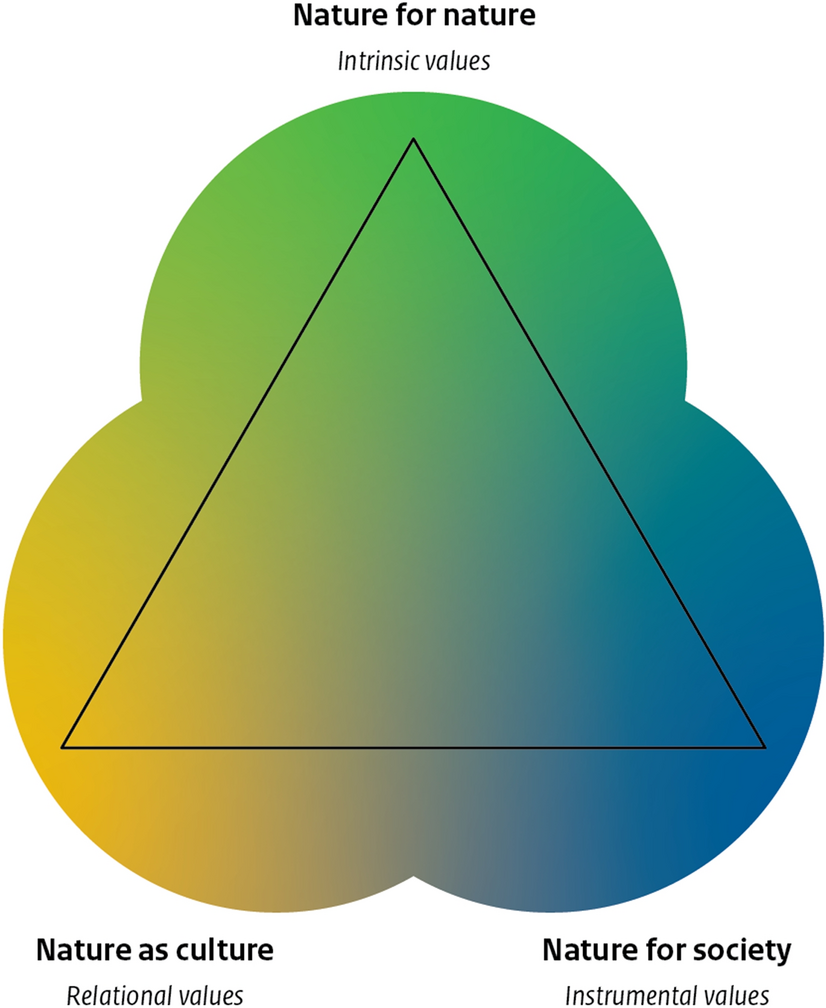
Figure taken from Durán et al. (2023).
In the INSPIRI visioning workshops, the NFF serves as a guide to co-create visions of desirable futures for EU seas and waters that align with different nature values, or a combination thereof.
For more information on the NFF and its application, visit: https://www.naturefuturesframework.org/
Seeds of Good Anthropocenes
In INSPIRI, we believe that pockets of desirable futures for EU seas and water already exist in the present – we call them “seeds”.
Seeds are innovative or exnovative initiatives that can take many forms: institutions, technologies, businesses, projects, partnerships, organisations, or simply alternative ways of thinking, doing, and being (Pereira et al. 2018). Seeds often experiment with novel social-ecological configurations, generating practical and contextualised solution-oriented knowledge and actions, and fueling bottom-up visions capable of redirecting unsustainable trajectories and that yet are still plausible and grounded in the present day (Bennett et al. 2016).
In INSPIRI, we gathered seeds across the case studies and used them as entry points for visioning. Seeds can be gathered directly from participants or identified by researchers. In some cases, the people behind these seeds participate in the workshops themselves, bringing their first-hand experience and aspirations to fuel the co-creation of visions for EU seas and waters. Importantly, we take special care to ensure a good balance of seeds representation across social, technological, environmental, economic and political dimensions, while speaking to different nature values following the NFF (see NFF details above).
For more information on Seeds of Good Anthropocenes, visit: https://goodanthropocenes.net/
Seeds, visions, pathways: a Mānoa Mash-Up approach to futures thinking
Engaging with futures is not a trivial task, and futures thinking does not mean wishful thinking. To engage with the futures of EU seas and waters in a systematic and systemic way, INSPIRI uses a collection of tools and sequential steps that together constitute a coherent and well-tested approach for the co-creation of participatory visions – the so-called Mānoa Mash-up method (CST Toolkit 2019).
The journey starts with identifying seeds for each case study that can fuel desirable visions (see seed details above). To do so, we invite workshop participants to reflect on the question:
What would this seed look like in the future if, instead of being an innovation at the margins, it became part of the mainstream?
From these “mature seeds,” participants build “Future Wheels,” a graphic brainstorming method that helps visualize the potential direct and indirect consequences or impacts of the seeds, were they to become part of the mainstream. Doing this in a participatory way allows many ideas to emerge. By repeating the process with different seeds, commonalities and differences, points of synergy, and key themes begin to surface, allowing us to distill some foundations for worldbuilding.
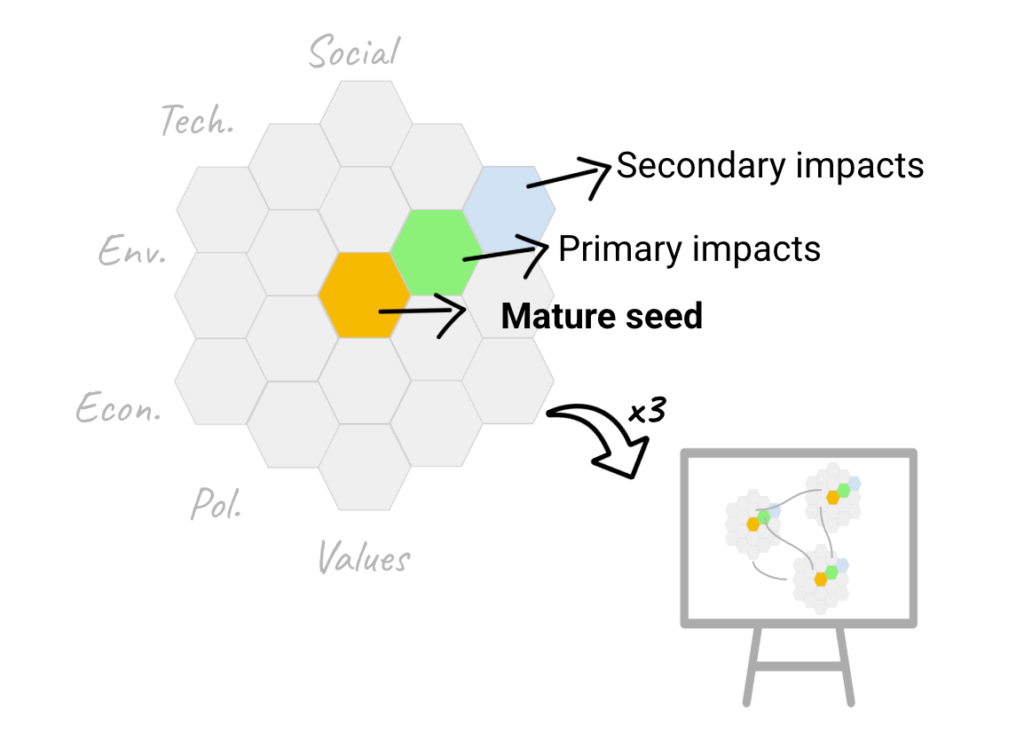
Figure from Gianelli et al. (2026). Used with permission.
However, complete visions are still far, and to move closer we draw on complementary tools. For example, we use the Verge approach (a.k.a. Ethnographic Futures Framework, Lum 2015), which, instead of emphasizing macro-categories (e.g., social, environmental, political), focuses on domains of human experience to explore how people personally enact, experience, and ripple change across daily life and prompt participants to develop ideas related to the futures being built: “What do people value in future societies? What do they eat? Where does their food and water come from?” By humanizing the co-creation experience in this way, the resulting futures become more relatable and tangible, giving workshop participants a better sense of what it would be like to inhabit them.
To materialize some of these ideas into a concrete description of the futures, many approaches can be followed. Participants can write snippets of the future in story form, using storyboards as templates or writing freely. Hands-on approaches such as collages are also a good way to visually “compose” a future world. Complementary future devices, such as newspapers or social media posts from the future, or postcards from the future, help encapsulate these futures into shareable ideas.
Once good descriptions of visions for the future are achieved, the next step is to identify how to move towards those futures through a pathway building process. To do so, we tap into another component of our futures thinking tool – the x-curve. The x-curve is a graphical tool that is used to explore change over time and is pivotal to move from visions to more complete scenarios. As a tool, it helps to think about how current systems decline (breakdown dynamics), how innovations and alternatives emerge (build-up dynamics), and how these dynamics interact during periods of transformation.
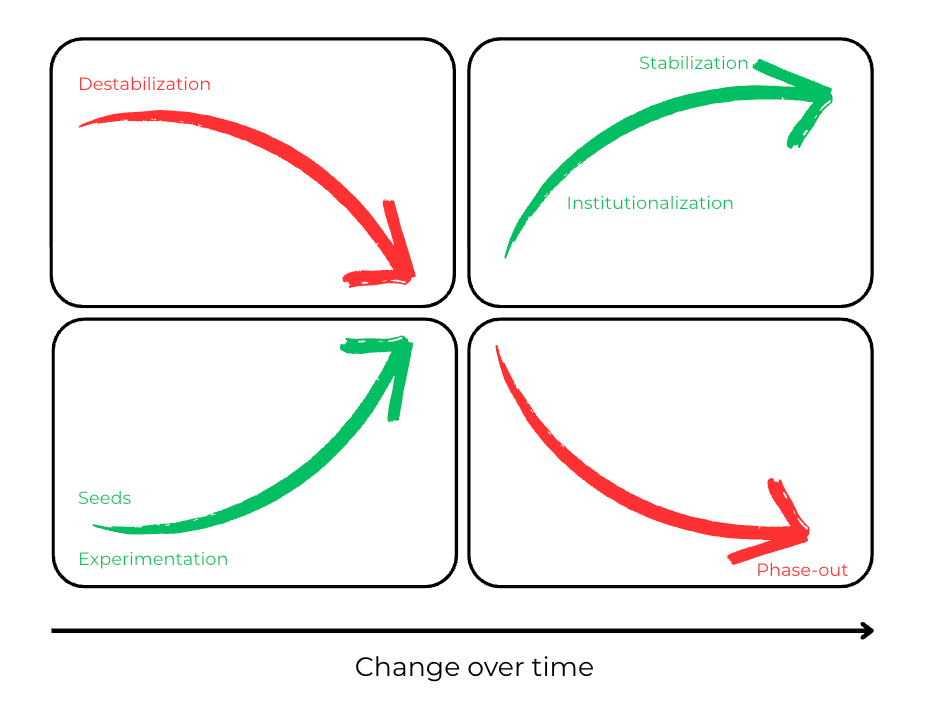
Own figure.
The left-hand side of the x-curve represents the dominant system as it currently exists, including promising initiatives or ‘seeds’ that both challenge existing patterns that need to be destabilized and have the potential to grow into more sustainable or equitable systems. The green line of the x-curve represents the emergence and scaling of these alternative practices, ideas, and innovations. Over time, and under the right conditions, these emergent elements can strengthen and eventually form the basis of a new dominant system. The red line of the x-curve represents the decline, destabilization, or deliberate phase-out of unsustainable or undesirable aspects of the current system. The centre, where the lines cross, represents the transition space, a period of instability in which elements of the old system lose coherence while new alternatives gain traction.
The x-curve can be used flexibly depending on the workshop goals and the sequence in which the elements are explored. For example, participants may start by mapping the current system and identifying what is being maintained or phased out. Alternatively, visioning can begin by examining existing positive initiatives (seeds) and exploring how these might scale into a desirable future system.
Key references
Bennett, E. M., Solan, M., Biggs, R., McPhearson, T., Norström, A. V., Olsson, P., … & Xu, J. (2016). Bright spots: seeds of a good Anthropocene. Frontiers in Ecology and the Environment, 14(8), 441-448. https://doi.org/10.1002/fee.1309.
CST Toolkit (2019). Generating visions of good anthropocenes:THE Mānoa Mash-up scenarios methodology. Edited by Tanja Hichert, Reinette Biggs And Rika Preiser.
Durán, A.P., Kuiper, J.J., Aguiar, A.P.D. et al. Bringing the Nature Futures Framework to life: creating a set of illustrative narratives of nature futures. Sustain Sci (2023). https://doi.org/10.1007/s11625-023-01316-1
Hebinck, A., Diercks, G., von Wirth, T., Beers, P. J., Barsties, L., Buchel, S., … & Loorbach, D. (2022). An actionable understanding of societal transitions: the X-curve framework. Sustainability science, 17(3), 1009-1021. https://doi.org/10.1007/s11625-021-01084-w
Gianelli, I., Pereira, L. M., Brun, V., Ahmadia, G. N., Ban, N. C., Bambridge, T., … & Claudet, J. (2026). Reimagining coral reef futures. npj Ocean Sustainability, 5(1), 10. https://doi.org/10.1038/s44183-025-00179-6
Lum, R. (2015). Working with verge. APF Compass, 5-8. https://ddtconference.org/wp-content/uploads/2017/07/lum-verge-apfcompass-april14.pdf
Pereira, L. M., Hichert, T., Hamann, M., Preiser, R., & Biggs, R. (2018). Using futures methods to create transformative spaces. Ecology and Society, 23(1). https://doi.org/10.5751/ES-09907-230119
Pereira, Laura M., Kathryn K. Davies, Eefje Den Belder, et al. 2020. “Developing Multiscale and Integrative Nature–People Scenarios Using the Nature Futures Framework.” People and Nature 2 (4): 1172–95. https://doi.org/10.1002/pan3.10146.